Breakthrough Findings in Pt. 2 of Indie Artist Survey
Last week we unveiled the initial findings from Intercept Music’s Indie Artist Survey. This week, we’ll drill down into the all-important findings about artists’ income, marketing choices, desire for business tools, and some of their frank observations about the music scene.
Before we share the findings, it’s again worth noting that the survey was of Indie Bible readers, and while it won’t be a perfect profile of the indie music scene, we believe in the quality of the data.
Here are survey findings #6 through #10:
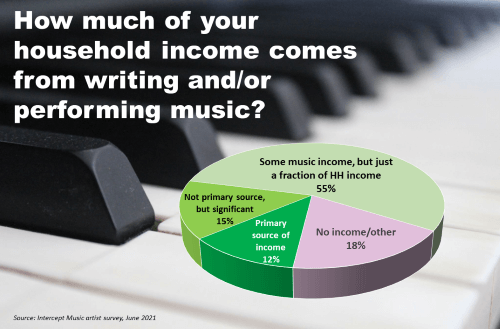
MUSIC PROVIDES SIGNIFICANT CHUNK OF INCOME FOR A QUARTER OF INDIE ARTISTS. There’s no doubt that all music makers would like to make their living off music. Flashing back to finding #5 from the previous post, we learned that 30% of the indie artists considered music to be their “full-time occupation.” If you line that up with the finding that music is the “primary source of household income” for just 12% of the respondents, a sizable portion of music artists are in the investment phase of their careers. From our perspective, that’s okay. The investment of writing songs, rehearsing, collaborating, recording, marketing, and touring are the very necessary stepping-stones toward success for an Indie Artist. Some artists are not looking for a substantial income stream from music; as one artist said, “I do it for personal joy more than money; I have other income.” Another artist pointed out, “My income comes from music, but not from my band. I write and produce music for advertising.”

INDIE ARTISTS ARE RAMPING UP THEIR RELEASE ACTIVITIES. About 43% of the musicians released a song within the three months before taking the survey in late June, but 62% of them plan to release a song within the next three months. With no way to perform live in front of fans, many indie artists resorted to a songwriting frenzy over the last year. Now that Covid-related restrictions have been relaxed in the U.S. at least, artists are gearing up for public performances again and releasing more music accordingly. “I am releasing three singles 6 weeks apart as a lead-up to our album release in October,” said one artist.
FACEBOOK LEADS MARKETING OPTIONS. Sixty percent of indie artists selected Facebook as effective for marketing their song releases. Facebook was the most popular option across all genres, including Hip-Hop and Pop artists. Other popular marketing avenues include emails/messages to fans and putting a video on the artist’s YouTube channel. Regardless of these options, many survey respondents expressed frustration about their not-always-successful marketing choices: One artist noted, “We’ve done a bunch of marketing, but it’s tough, and I’m not happy with the results. Social media is inconsistent and costs too much, and ads are ineffective.” Another stated, “Sorry, it’s impossible without a label. I have been at this for 10 years,” yet another lamented, “I just wish that I had more money to put into social media ad campaigns, Spotify direct ad placements, etcetera.”

INDIE ARTISTS NEED MARKETING, LICENSING SUPPORT. When asked which support options would be important to them, indie artists overwhelmingly asked for marketing support, especially the imperative “promotion to playlist influencers/curators” choice and social media. Half of the musicians saw opportunities in licensing sync rights to their songs, such as for movies, gaming and ads. Good thinking! Sync-rights is a fast-growing source of music revenue. Some of the choices were practical in nature, such as video production, graphics design and merchandise fulfillment. Some 44% of respondents wanted “personal guidance, education and expertise.” One artist summed up the support question perfectly: “I’m a singer/songwriter, and I arranged and produced my albums myself. But nowadays, I’m also supposed to know about sound engineering, digital marketing, and advertising, in which I have no interest and takes a lot of time from what I’m supposed to do: write, record and perform live music.”

INDIE ARTISTS HAD PLENTY TO SAY ABOUT THEIR ROLE IN THE INDIE MUSIC BUSINESS. Some of their key takeaways:
“I wish that distributors acted in a more humane way with artists. Whenever you have a problem and ask them about it, their immediate response is to refer you to FAQs. They also talk in a language that artists do not understand.”
“Self-promotion is hard work and slow. So any information covering how to do this more effectively, such as with a timeline of when to do what before a release, would be helpful.”
“The most difficult thing about being an independent artist, aside from the everyday business aspects, is ensuring that the registration is done properly with the correct organizations for the various royalty streams. This area is the most difficult because organizations may not collect all royalties, and when you are your own label and publisher, it’s hard to keep it all straight.”
“It’s so difficult … help!!!”
Intercept Music conducted this survey of indie artists to understand the challenges and speed bumps to a successful career. Our staff is made up of music industry veterans (and rookies!), all of whom passionately believe that the music spectrum would not be complete without the contributions of independent artists. And to that end, we exist to help indie artists achieve their full potential.
If you’re planning to release a new song, Intercept Music can be a great distribution and marketing partner. Send us an email and a real human will reply with a menu of services.